



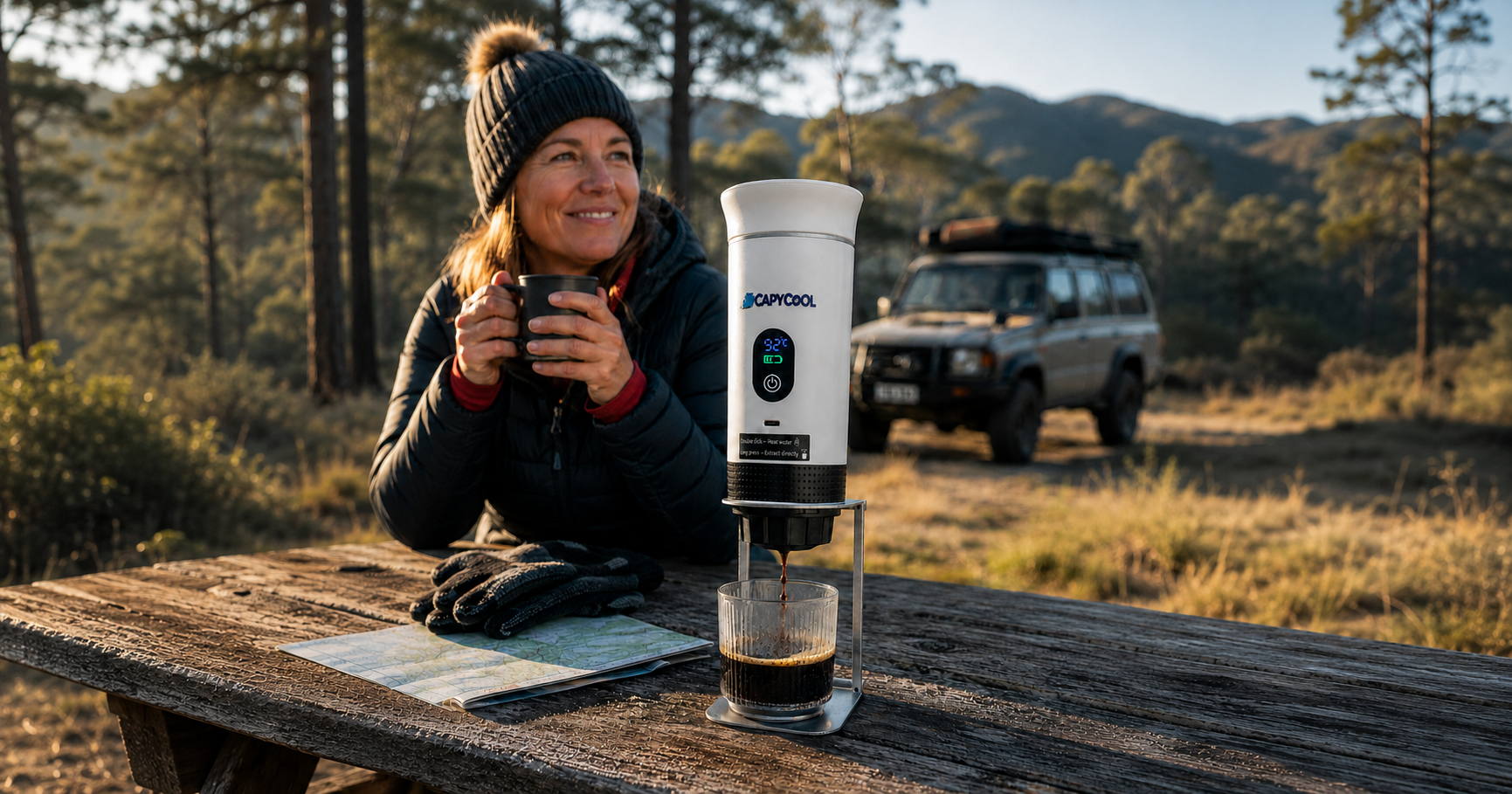
We are a nation that takes coffee seriously. We invented the flat white (or fought New Zealand for the title), we turned our backs on the big chains, and we built a café culture the rest of the world copies. So here is the odd part: the second we leave the house for a camping trip, a road trip or a long day on a worksite, most of us settle for sad instant or a servo cup that tastes like it was brewed last Tuesday.
A portable espresso machine fixes that. It pulls a genuine pressurised shot from real coffee, runs off a battery, and fits in a glovebox. Below is the honest case for why one belongs in your kit, backed by the numbers, the real scenarios where it earns its keep, and straight answers to the questions buyers actually ask.
The Aussie coffee obsession is real, and the data proves it
Australians drink around 16.3 million cups of coffee every single day. More than 75% of adults have at least one cup a day, and close to 90% say they like coffee to some extent. A quarter of us say we simply cannot get through the day without it.
We are also fussy in the best way. When Australians rank what matters in a coffee, taste and quality come out on top by a mile, well ahead of price and speed. Our café scene reflects that: roughly 95% of coffee shops here are independent, not chains. We have trained ourselves to expect a real espresso, not a freeze-dried compromise.
Here is where the gap shows up. We are also a country that loves the outdoors. Australians took a record 17.3 million caravan and camping trips in 2025, a 14% jump on the year before, and there are now almost 938,000 caravans and campervans registered around the country. Add the daily commuters, the tradies on site, the four-wheel-drivers and the overseas travellers, and you have millions of coffee snobs who regularly find themselves a long way from a decent machine.
That is the whole problem a portable espresso machine solves. You keep your standards when you leave your kitchen.
What a portable espresso machine actually is
A portable espresso machine is a hand-sized device that builds real pressure to extract espresso, the same principle as the big machine at your local café, just shrunk down and made to run anywhere.
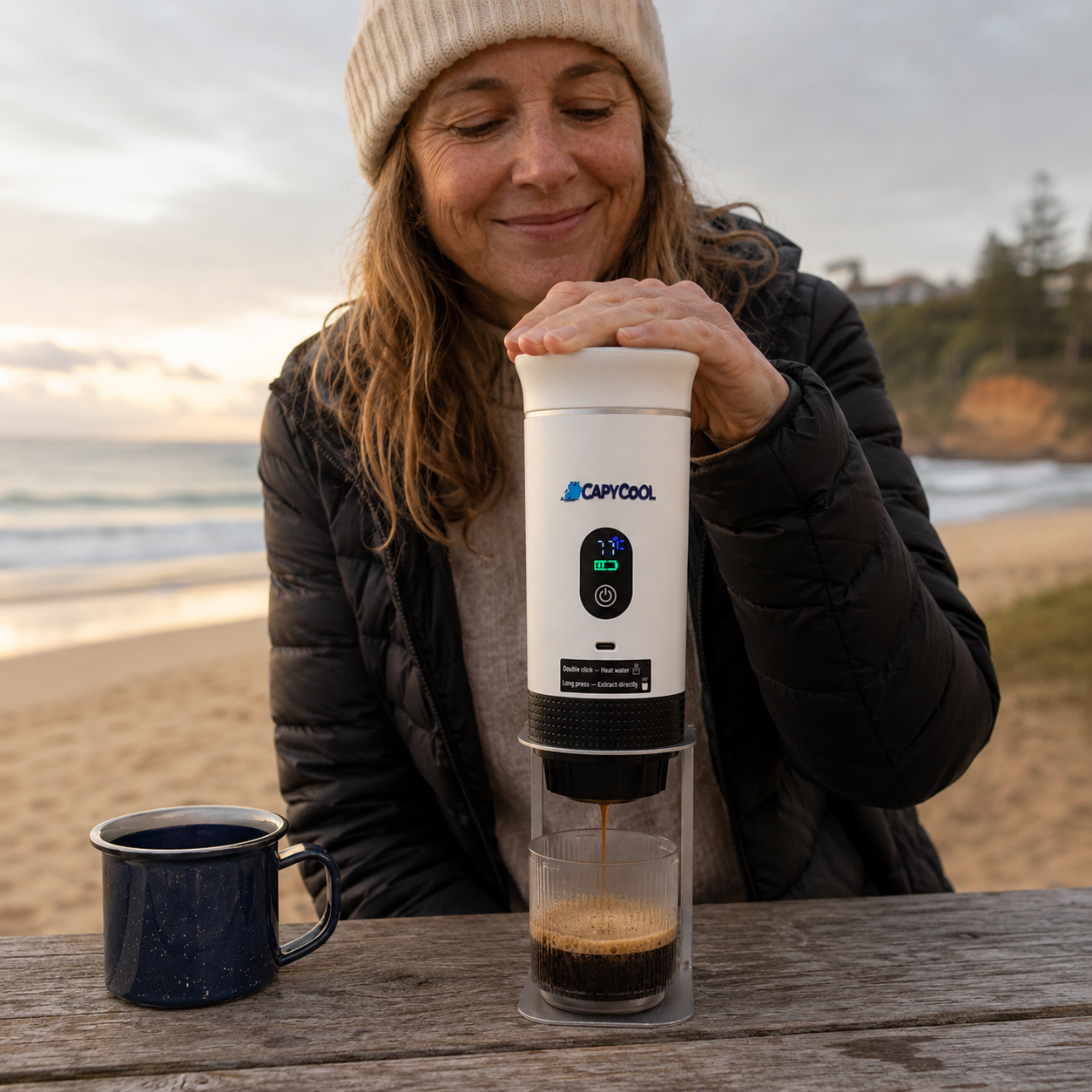
The CapyPress is a 3-in-1 version, which means it works three ways:
- ●Ground coffee for people who grind their own and want full control
- ●Nespresso-style capsules for speed and zero mess
- ●Battery powered so you are not tied to a wall socket or a car outlet
You add hot water for a hot shot, or cold water for a cold extraction, load your coffee, and the machine does the pressurised work. No barista, no power point, no queue.
A quick honest note up front, because it matters more than any sales line: this is not a café machine and it does not pretend to be. It beats instant comprehensively, it travels where a café cannot, and it costs a fraction of a benchtop machine. Set that expectation and it delivers every time.
“It ain’t barista coffee, but when you’re three hours from the nearest servo, a hot espresso in minutes is a dream.”
The real scenarios where it earns its place
1. Camping and caravanning off-grid
This is the obvious one and the strongest. With 17.3 million caravan and camping trips taken in 2025 and 90% of caravan nights spent in regional Australia, a huge number of Aussies wake up each morning nowhere near a café. Instant coffee at a campsite is a rite of passage nobody actually enjoys.
A battery-powered espresso machine changes the morning. You boil water on the camp stove, load your grounds or a pod, and pull a real shot beside the fire. Pair it with a power bank and you have several days of proper coffee without a powered site. For grey nomads doing the big lap, that is not a luxury, it is a daily quality-of-life upgrade.
2. The early-start tradie and worksite crew
Site coffee is usually a thermos of something regrettable or a servo cup on the way in. A portable espresso machine in the ute means a real shot at smoko without leaving the job. It is small, it is tough, and it does not need the site to have power. For anyone starting before the cafés open, that first proper coffee on site is worth a lot.
3. The road trip and the long drive
Around 23% of Australian coffee is bought as takeaway, and a good chunk of that is the highway servo stop. Those stops cost time and money, and the coffee is a gamble. Carry your own machine and the rest area becomes your café. You control the beans, you skip the queue, and you are back on the road faster.
4. Overseas and interstate travel
Plenty of seasoned travellers refuse to leave coffee to chance abroad. A compact machine in your luggage means hotel-room espresso that actually tastes like home, wherever you land.
“I’m a coffee snob and like to take my own coffee. Perfect for overseas travel.”
5. The office, the boat, the shed, the festival
Anywhere with people and no good coffee is fair game. Bad office machine? Bring your own. Day on the water? Sorted. The point of portable is that it goes where you go.
The money side: it pays for itself faster than you think
Here is the maths that makes the decision easy. The average employed Australian who drinks coffee spends roughly $1,000 a year on it, at $2 to $5 a cup, with a latte averaging around $3.96 and a flat white around $3.99.
A portable espresso machine is a one-off cost, then you are only paying for beans or pods. If it replaces even a few bought coffees a week on trips, commutes and site days, it pays for itself inside a season. Compare it to a benchtop machine too, and you are getting real espresso for a fraction of the kit cost and none of the bench space.
“Does the exact same thing as a $300 machine I’ve seen but for under 100 bucks.”
What to look for in a portable espresso machine
If you are shopping the category, judge any machine on these:
- ✓Coffee flexibility. Can it take both ground coffee and capsules? A 3-in-1 like CapyPress means you are not locked into one supply chain.
- ✓Power source. Battery-powered beats hand-pump-only for genuine off-grid use. Check how it charges and whether it pairs with a power bank.
- ✓Hot and cold capability. Hot shots draw more power, so cold extraction gives you more cups per charge. Useful to know before a long trip.
- ✓Build quality. It is going to live in a glovebox, a pack or a toolbox. A solid metal finish lasts where flimsy plastic does not.
- ✓Australian support. Local stock, local warranty and local dispatch matter. Buying from an Australian-owned business with a Sydney warehouse means you are not waiting weeks on an overseas return.
Frequently asked questions
Is it real espresso?
Yes. It builds genuine pressure to extract a proper shot from ground coffee or a capsule. It is not identical to a commercial machine, but it is a real espresso, not instant.
How many coffees do I get per charge?
It depends on hot versus cold. Hot shots use more power because heating water draws the most energy, so expect around 3 to 5 hot cups per charge. Cold extractions go further. Pairing it with a power bank extends that comfortably for longer trips.
Does it heat the water itself?
The CapyPress works with hot water you supply (from a kettle, camp stove or thermos) for a hot shot, or cold water for a cold brew. Check your model’s instructions before first use.
Does it work with Nespresso pods?
Yes, it works with standard Nespresso-style capsules as well as ground coffee. One thing to flag: it is not compatible with the larger Nespresso Vertuo pods, so read the fine print and stick to standard capsules or grounds.
How long does it take to recharge?
Recharge time is on the longer side, which is normal for a device that has to heat and pressurise. Plan to charge it overnight or top it up via a power bank during the day so it is ready when you are.
Is it worth it over just buying coffee out?
If you regularly drink coffee away from home, the maths is strongly in your favour. At a typical $1,000 a year on bought coffee, a one-off machine plus beans pays for itself fast, and you stop gambling on servo cups.
Should I get the carry case and stand?
If the machine is living in a vehicle or pack, a carry case protects it from knocks, and a folding stand makes pouring on uneven camp surfaces far easier. Both are worth considering for off-grid use.
The bottom line
We are too serious about coffee to keep accepting bad coffee the moment we step outside. With millions of us camping, road-tripping, commuting and working away from a decent machine, the gap between what we expect and what we settle for is enormous. A portable espresso machine like the CapyPress closes that gap. Real coffee, anywhere, for the cost of a few bought cups.
The CapyPress runs on grounds or capsules, works hot or cold, and is built to live in your car, van or pack. Australian-owned, dispatched from our Sydney warehouse.
Shop the CapyPress →









Share:
Why Aussies Love CapyCool Fans: What 900+ Reviews Reveal
Clip On Fans Australia: The Complete Guide to Clippable Cooling in 2026